

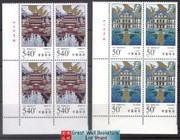
China Stamps - 1998-19 , Scott 2887-88 Puning Temple in Chengde and Wurzburg Palace (Jointly Issued by China and Germany) - MNH, VF : These stamps were jointly issued by China and Germany with the purpose of displaying the architectural gems of different styles between the East and the West.The Puning Temple, located in Chengde of China's Hebei Province and commonly called the Big Buddha Temple. Is the most famous temple complex among the Eight Outer Temples in the Imperial Summer Resort in Chengde. This temple began its construction in the 20th year of Emperor Qianlong of the Qing Dynasty and was completed in four years. It is big in scale and completed in four years. It is big in scale and complete in structures, and also draws on the temple architectural styles of Tibetan Buddhism. In the Mahayana Hall in the rear of the temple architectural styles of Tibetan Buddhism. In the Mahayana Hall in the rear of the temple stands a 22.28-meter-high and 110-ton Avalokitesvara Buddha statue with a thousand hands and a thousand eyes made of engraved wood and painted gold. This is the highest and heaviest engraved wood Buddha statue in the world, and is a masterpiece of Buddhist artistic history in China and the world.Wurzburg Palace is Germany's "Palace Museum", which is located in Wurzburg, Bavaria of Germany. Its construction started in 1720 and completed in 1744. It is the biggest and most magnificent palace architectural complex in Germany, and is called "palace of palaces". The imperial church of the main building is typical of the Bavarian style. The imperial church of the main building is typical of the Bavarian style. The huge ceiling paintings of the church and residential palace of emperors are simple imposing and breathtaking. In 1981, the palace was listed in the Catalogue of World Cultural Heritage.

China Stamps - 1998-19 , Scott 2887-88 Puning Temple in Chengde and Wurzburg Palace (Jointly Issued by China and Germany) - MNH, VF - (92887)
Great Wall Bookstore, Las Vegas
$2.50
(No reviews yet)
Write a Review

Write a Review
Great Wall Bookstore, Las Vegas
China Stamps - 1998-19 , Scott 2887-88 Puning Temple in Chengde and Wurzburg Palace (Jointly Issued by China and Germany) - MNH, VF - (92887)
- SKU:
- 92887
- UPC:
- -


Great Wall Bookstore, Las Vegas
China Stamps - 2003-19, Scott 3309-10 The Art Books (Jointly Issued by China and Hungary) - MNH, F-VF - (93309)
$1.95

Great Wall Bookstore, Las Vegas
China Stamps - 2005-9, Scott 3433-34 Paintings (Jointly Issued by China and Liechtenstein) - MNH, F-VF - (93433)
$1.95

Great Wall Bookstore, Las Vegas
China Stamps - 2002-3 , Scott 3174-75 Rare Flowers (Jointly issued by China and Malaysia), MNH, F-VF - (93174)
$1.95