

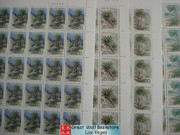
China Stamps - 1996-7 , Scott 2671-74 Cycads - MNH, F-VF : Cycads, palm-shaped, has only one family-cycadaceae, and about 10 existent genera, scattering in tropical and subtropical regions. All varieties in the cycadophyta are also called cycads, which include four original gymnospermous orders: pteridospermales, cycadales, pentoxylales and bennettitales or cycadeoidales.The cycadophyta plants were originated in the Mesozoic Era, and now only the cycadales survives. With a big palm-shaped crown, and penniform compound leaves, cycad has strobilus nesting on the top. Some cycads have tall, branchless, armor-like trunks; others have bulgy, barrel-like ones. The woodiness of cycad is both thin and soft.Pollinated by wind, the dioecious cycads usually grow very slowly, and can be used as greenhouse ornaments. Some varieties, however, can grow outside the greenhouse. Honored as "the grand panda in the plant kingdom", the cycad is regarded by international botanists as playing a significant role in the research of the origin and evolution of seed plants, and also the research of the vicissitudes of ancient geology and climate. The natural extinction process of the plant speeding up, people begin to take cycad as the key research and protection object.The starch in the stems of some varieties of cycad is edible after eliminating alkaloid by cooking. The tender leaves and seeds of some cycads are also edible.There are wild cycads scattering in the eight provinces and autonomous regions in southern China, an important cycad distribution center in the world. They include 15 varieties, all of them are of cycadaceae. On May 1 to 5, 1996, the fourth International Cycad Biology Conference was held in Panzhihua City, in southwestern Sichuan Province.

China Stamps - 1996-7 , Scott 2671-74 Cycads - MNH, F-VF - (92674)
Great Wall Bookstore, Las Vegas
$2.95
(No reviews yet)
Write a Review

Write a Review
Great Wall Bookstore, Las Vegas
China Stamps - 1996-7 , Scott 2671-74 Cycads - MNH, F-VF - (92674)
- SKU:
- 92674
Great Wall Bookstore, Las Vegas
China Stamps - 1996-7 , Scott 2671-74 Cycads - Full sheet of 50 - MNH, F-VF - (9267A)
$34.95

Great Wall Bookstore, Las Vegas
China Stamps - 1996-7 , Scott 2671-74 Cycads - Imprint Block of 4 - MNH, F-VF - (9267D)
$9.95

Great Wall Bookstore, Las Vegas
China Stamps - 1996-8 , Scott 2676 Ancient Architecture - MNH, F-VF - (92676)
$2.25

Great Wall Bookstore, Las Vegas
China Stamps - 1993-7 , Scott 2444-7 Bamboo - MNH, F-VF - (92444)
$1.95

Great Wall Bookstore, Las Vegas
China Stamps - 1996-1 , Scott 2641-42 1996 Year of Rat, MNH, F-VF - (92641)
$2.15